Improve your Prose by Varying Sentence Length

Jed Herne's avatarJed Herne: Writer

Whatever you’re writing, there’s one sure-fire way to make your prose more engaging:

Vary the length of your sentences.

Rather than explain why this is important, I’m going to give an example:

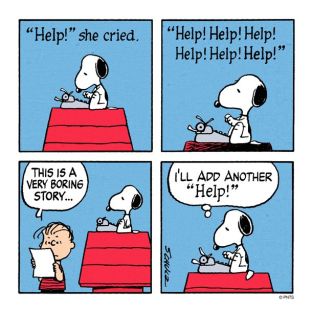
This sentence has five words. Here are five more words. Five-word sentences are fine. But several together become monotonous. Listen to what is happening. The writing is getting boring. The sound of it drones. It’s like a stuck record. The ear demands some variety.

Now listen. I vary the sentence length, and I create music. Music. The writing sings. It has a pleasant rhythm, a lilt, a harmony. I use short sentences. And I use sentences of medium length. And sometimes, when I am certain the reader is rested, I will engage him with a sentence of considerable length, a sentence that burns with energy and builds with all the impetus of a crescendo, the roll of the…

View original post 289 more words

EDITING 101: 48 – Using Quotes in Your Book and Research Tips – Part 1…

Chris The Story Reading Ape's avatarChris The Story Reading Ape's Blog

Originally posted as the Dun Writin’—Now Whut? series on this blog, EDITING 101 is a weekly refresher series for some of you and brand new for others.

Courtesy ofAdirondack Editing

Using Quotes in Your Book and Research Tips (Part 1)

As often as I run into authors wanting to use song lyrics in their novels, I also run into authors wanting to use quotes in their non-fiction books. (If you missed the post about using song lyrics in your manuscript, you can find it HERE 101:08) It seems that many authors like the way somebody else said something previously and don’t think they can say it any better.

Well, I don’t know about that. But I do know that you cannot simply take someone else’s words—no matter how wonderfully written—and plop them into your for-sale book. That’s plagiarism. And, you cannot simply use a significant amount of material…

View original post 990 more words

Promote Your Book Better With Universal Buy Links…

Chris The Story Reading Ape's avatarChris The Story Reading Ape's Blog

by Derek Haines  on Just Publishing Advice site:

When a potential book buyer clicks on your book link, where do they end up?

If they live in Scotland, do you send them to Amazon US? If they live in South Africa, do you send them to Amazon UK?

If you do, you have probably lost a great chance to sell a book because book buyers in the UK cannot buy books from Amazon US, and nor can South African buyers use Amazon UK.

Do you open publish? Yes? Great. But how do book buyers who use Apple iBooks or Kobo buy your book? Certainly not from your Amazon Kindle link.

Using one store link for your book promotion, such as to Amazon Kindle US, will work for US buyers, but what about the rest of the world? I know from experience, and my own book sales, that there are keen…

View original post 62 more words

What Would You Write If No One Was Looking?

theryanlanz's avatarRyan Lanz

by Destine Williams

Hey everybody, today I wanted to do another Day In the Life post. And for today’s topic, I wanted to shift our focus inward and talk about something that’s been on my mind a lot these days. It’s this idea of being more honest when we write, draw, compose, or just create well…anything.

On Where This All Came From…

You see I’ve always had this feeling before I had the words to express them, but it was finally cleared up for me when I heard about artists that have sketchbooks that are made for the sole purpose of showing people and separate sketchbooks that are just for them.

View original post 824 more words

Scrivener Backups and Snapshots Strategies Pt. 2

P. H. Solomon's avatarStory Empire

Hello to all the SE readers! Last time I posted, the topic was about Scrivener and backups. Today, I’m visiting a similar subject with Snapshots.

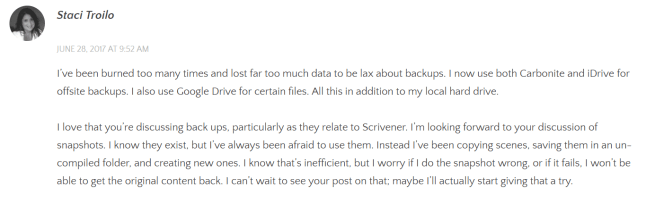
Story Empire’s very own Staci Troilo left a comment on the previous post (thanks, Staci) indicating her method of backup as well as her thoughts about snapshots:

So with that thought in mind, let’s cover what a snapshot is, why you might use this feature and how to manage them.

What Are Snapshots?
Snapshots are used to make a quick backup of all (meaning you can choose to take snapshots of multiple documents with a project) or part of your project within in the project. Scrivener saves as you work so point-in-time versions are not available without backups and snapshots.

Why Use Snapshots?
Why would you want to do this? If you want to make big changes but you’re not sure you will keep…

View original post 628 more words

Why Threatening your Protagonist ISN’T the Best Way to Create Suspense

Jed Herne's avatarJed Herne: Writer

We often think that suspense = dramatic stakes. The higher the stakes, the higher the suspense. Thus, threatening the character with whom readers have the most connection should create the most suspense, right?

Wrong. Yes, threatening your main character will enhance suspense. However, you’ll never achieve super-high levels of suspense because readers know you won’t really kill your hero halfway through the novel.

So, by all means – threaten your main character. But to achieve even more suspense, don’t threaten your protagonist: threaten the things your protagonist values.

Why You Should Threaten Values:

As I said before, readers know your hero’s probably going to survive. This limits the suspense you can create by endangering your main character.

However, readers don’t know if your hero’s best friend will survive. Or his/her loved one. Or his/her prized 1950s sports car. Or his/her cat.

It doesn’t just have to be people’s…

View original post 154 more words

What’s the Most Important Part of Your Novel?

Does your first chapter make a promise to readers? Do you live up to it? #WritersIssues

Writing your first novel-Some things you should know's avatarWriting your first novel-Things you should know

1e7cba28f25210164154825f3d16c176It’s the beginning and more specifically the first sentence, then paragraph, then page, then chapter. You have to grab your reader the minute they pick up your novel.

When you are ready to submit your work to an agent, one thing you will notice is they don’t want your complete work. They only want the first few pages, or some may ask for a couple of chapters. Don’t be bold and overconfident sending them the entire thing.

They probably will toss it to the side for your failure to follow instructions. If they do read, they won’t get very far if the first few pages aren’t compelling enough to draw them in (which was the part they wanted to see in the first place).

Agents as a rule, don’t want to see the entire manuscript until they know you can write a compelling story. You have to make them want to…

View original post 164 more words

Becomming a Better Fiction Writing using Passive Learning

Excellent post! 😉

Jed Herne's avatarJed Herne: Writer

The single best way to improve your creative writing is to do lots of creative writing.

However, it can be hard to make time to write short stories, poems or even novels. That’s why you should include as much writing-related passive learning into your day as possible.

Passive learning is essential learning to do a task by performing other similar (yet not identical) tasks. For creative writing, passive learning is a bit like sneaking vegetables into a brownie – it won’t feel like you’re writing fiction, yet your fiction writing will improve.

View original post 217 more words