Writing

Why Realism is Essential

If your story lacks realism, readers will be disappointed.
Why? Well, good novels encourage readers to suspend their disbelief; to believe that the story is real, even though it’s obviously fiction. Without realism, readers will find it hard to think your story is, well, real.
Now, coming from a guy whose most recent story was about spaceships, you’re probably a little confused. Does the need for realism impede you from writing about anything you can’t see or experience?
The answer, of course, is no. Stories about aliens, superheros, or medieval vampires can all be 100% realistic, because realism isn’t about stories being true to our world. It’s about stories being true to themselves.
View original post 351 more words
Creative Writing vs Writing as Therapy
Throwback Thursday: How to Write a Novel That Will Actually Be Worthy of Publishing

5 Tips for Writing Effective Settings
Good info – add to bookmarks!
After character, plot and theme, setting is arguably one of the most important elements of a novel. ‘Setting’ refers to the location for which events occur, and can be used to:
Use the 5 senses to Immerse Readers
The most effective settings are those that plunge readers into a story’s world. By vividly portraying a setting’s sensory experience, readers’ imaginations will flourish, allowing them to feel like they’re inhabiting your story.
When using the 5 senses (sight, sound, taste, touch and smell), focus on touch, taste and smell. Too often, writers over-focus on sight and sound. This can come from trying to write as if your book was a movie, which has a strong reliance on these two senses.
View original post 578 more words
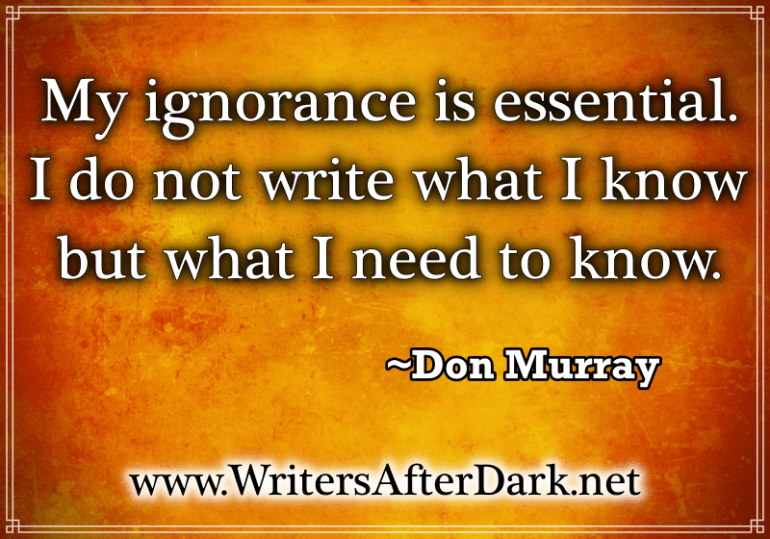
#MotivationalFriday – #Quotes to Live and #Write By
Naming Your Baby, I Mean, Ah, Book
Great food for thought! How do you name your books?

I read books. I read lots and lots of books. Which, even though Stephen King says you can’t be a good writer if you don’t have time to read, is actually unusual for a writer. Most writers, especially those who don’t have much time to write, spend their time writing. That makes sense, right? Right. But I read a lot of books, and sometimes I’ll have an epiphany.
Right now I’m reading Making More Money: Habits, Tactics, and Strategies for Making a Living as a Writerby Honoree Corder and Brian D. Meeks, and I had an epiphany.
How does a writer title their books, short stories, blog posts?
I suck at it.
And that was my epiphany.
No, not that I suck at creating titles for my books and stories. I knew that already.
No, I realized that On the Corner of 1700 Hamilton is the worst book title…
View original post 542 more words
So You Think You Can’t Write?
Protect Your Summer Writing Time!
Summer is here!
Sum mer is here and the kids are out of school. Maybe you can sleep in a little more, and dinner is certainly easier to make—just throw some steaks on the grill and open that container of potato salad you bought yesterday at the deli.
You would think that with the arrival of summer you would have more time to write. Right? The days are longer making it easier to stay up at night; the kids don’t have activities they need to be driven to every afternoon. Maybe the workload at your job is a little lighter.
This all sounds good in theory, but the reality is, summer takes up a lot of time. Things don’t change much if you still need to get the kids to daycare or summer day camp, and your evenings are just as packed as they used to be with getting everyone…
View original post 433 more words
Harvesting the Crop of your Writing
The common sense approach wins every time! 😉

Hello SEers! Welcome to another Monday Blog. Today, I thought I’d write about how to harvest the crop of your writing, and to that end, I am re-using the fertile soil of an old article I wrote for an online writing mag that has now, sadly, closed its doors. I make no apologies for my … ahem … artwork 🙂
To write a book is to become intimate with change. And, if we do it right, we’ll have something to harvest at the end of the process. As with any process, while each individual step is important, timing is everything. We need to know when to interfere, and when to leave well alone. Whether the problem be over-watering, or under, the end result will be the same: The seed of imagination will never make it to a full grown, published and successful book.
So, how do we best harvest the…
View original post 1,860 more words
 Felicia Denise, Author